

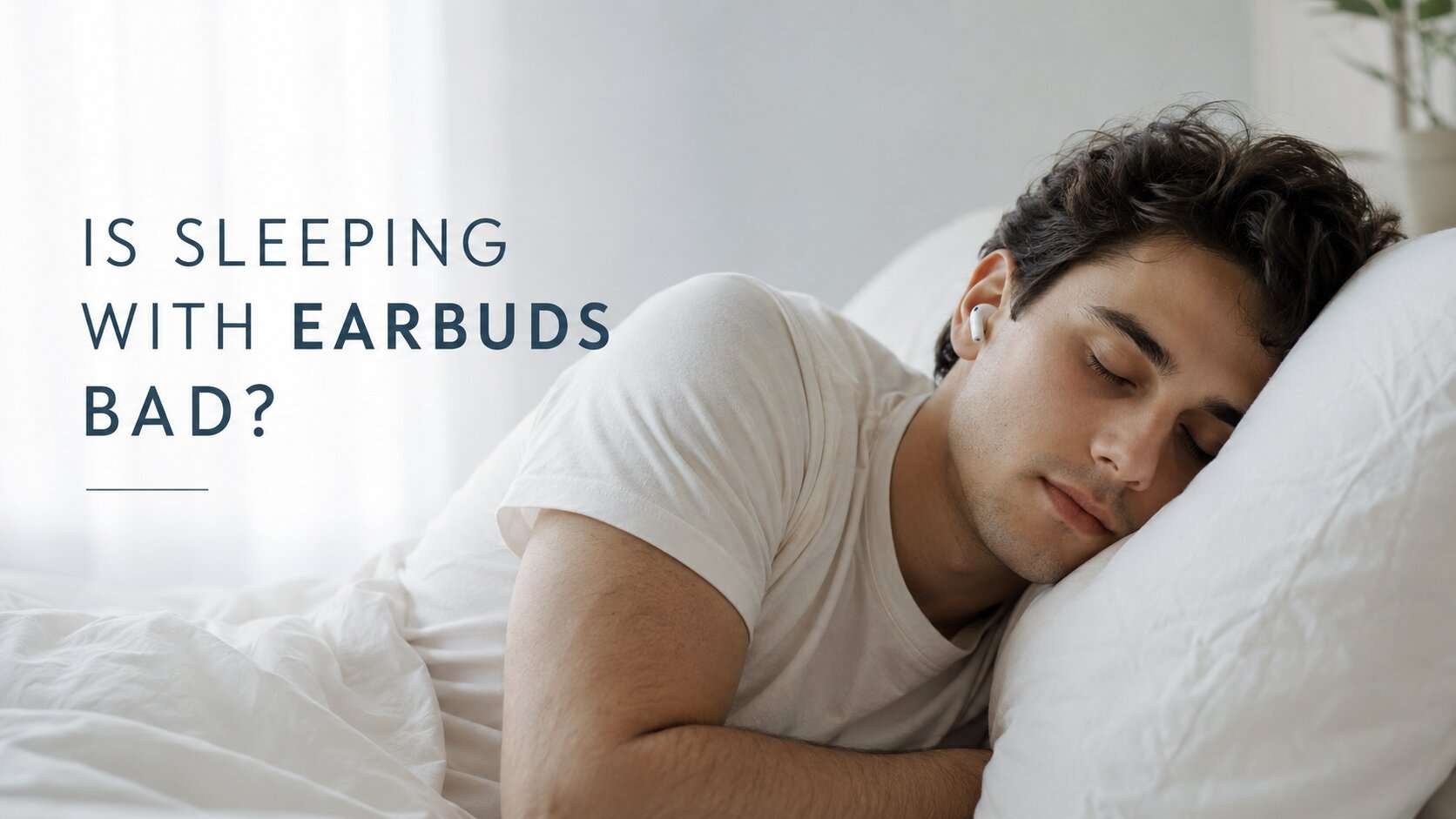
Sleeping with earbuds is not automatically harmful, but it carries real risks that depend on how you do it. An occasional night with quiet, steady sound and a comfortable fit is a very different thing from all-night, every-night listening at a moderate volume through a sealed earbud. Most of the harm comes from four things: how loud the audio is, how long it plays, how long the canal stays blocked and damp, and how much pressure your pillow puts on the earbud.
| Your situation | Main concern | What to change |
|---|---|---|
| Occasional use, quiet sound, timer on | Low | Check fit and keep the volume low |
| Nightly, all-night, sealed in-ear earbuds | Higher | Lower the volume, use a timer, take earbud-free nights, consider a different format |
| Side sleeper with sore ears | Pressure and irritation | Switch to a lower-profile design or a non-ear option |
| Noise cancelling on while you sleep | Missing alarms and calls | Turn it off or use passive noise reduction |
| Ringing in the ears (tinnitus) | Wanting sound all night | See the tinnitus section |
| Current ear infection, ear-canal eczema, or chronic middle-ear disease | Higher risk of problems | Ask a doctor before using anything in the ear |
Hearing damage depends on loudness and duration together. NIOSH's limit trades loudness against time. Each 3 dBA step above 85 dBA cuts the recommended daily exposure in half.
| Average level | Safe time at that level |
|---|---|
| 85 dBA | 8 hours |
| 88 dBA | 4 hours |
| 91 dBA | 2 hours |
| 100 dBA | 15 minutes |
Sleep is different from most listening because it is a long, daily exposure. Weekly-allowance standards used for personal audio are more conservative than the workplace limit. They cap the weekly dose at the equivalent of 80 dBA for 40 hours, and Apple's headphone notifications use the same idea, alerting you after more than 80 dB for 40 hours total in seven days.
Sleeping eight hours a night is 56 hours a week. Using the standard 3 dB trade-off, that puts the ceiling near 78 dB, even if you listen to nothing else all week. That figure is our own calculation from the published framework, not an official sleep guideline. Daytime listening uses the same budget, so aim well below it.
The same slider position can be much louder on one pair of earbuds than on another. Check your actual level instead:
Readings can be less precise with some third-party earbuds, so treat them as a guide.
Steady sound such as rain, pink noise, or brown noise holds a predictable level. A podcast or song can carry sudden peaks, such as a loud ad, a dramatic music passage, or a louder next episode. If you fall asleep partway through, you don't control what plays next. Steady, low-level audio on a timer is the more predictable choice.
We did not find a study that measured hearing outcomes in people who sleep with earbuds. The guidance above comes from general noise-exposure research, which is built mostly on waking and workplace exposure. Treat it as a reasonable precaution, not proof of what happens during sleep.
Earbuds can seal the ear canal. Two problems follow.
Earwax. Earbuds can compact wax deeper into the canal. Depending on how much builds up, you may notice muffled hearing, ringing, or a plugged feeling, and some people need a clinician to clear it. Digging with cotton swabs tends to make this worse.
Moisture and infection. Moisture that stays sealed in the canal overnight, especially after a shower, can encourage bacterial growth and raise the chance of an outer ear infection. The skin lining the canal is also easy to scratch, and small scratches can let irritation or infection take hold.
ENT guidance on earplugs advises avoiding them with an active ear infection, ear-canal eczema, or chronic middle-ear disease, and says people with diabetes or weakened immune systems should take ear-canal irritation more seriously. That advice is about earplugs, but the logic of blocking a vulnerable canal for hours applies to sealed earbuds as well.
If you sleep on your side, the earbud sits between your head and the pillow. That can cause pain and irritation, and poorly fitting earbuds can damage the skin in the canal over time. Soreness that wakes you is a signal to change the setup, not to push through it.
One related condition is often blamed on earbuds without good reason. Chondrodermatitis nodularis helicis, sometimes called "pillow ear," is a painful inflammatory nodule of the ear's skin and cartilage that often prevents sleeping on the affected side. It usually appears on the ear of the preferred sleeping side, which suggests pressure from the weight of the head, and it typically affects the outer rim of the upper ear. That makes earbuds an unlikely main cause, though pressure from other devices has been described in the medical literature. If you have persistent one-sided ear pain, get it checked rather than assuming the cause.
Sometimes, and the evidence is weaker than most articles imply.
The benefit appears to come from the sound, not from putting it in your ear canal. If sound helps you, use the least invasive way to deliver it.
Comfort counts too. "Bad" can also mean bad for your sleep. A bud that presses on your ear, falls out, or beeps at 3 a.m. can cost you more rest than it gives.
Many people with ringing in the ears want sound at night. Audiologists note that people with tinnitus are the group most commonly interested in sleeping with headphones. Masking sound can make tinnitus less noticeable, but it doesn't make it go away.
No evidence points to one best device. A health-technology review found the evidence did not cover specific types of device used to deliver sound, including pillow speakers. A flat, low-profile pillow speaker or a bedside sound machine avoids the ear canal entirely. If your ringing is new, one-sided, or getting worse, see an audiologist or doctor first.
Comfort and safety are different questions. A smaller or softer bud may help with side sleeping, but it does not fix volume or moisture. The options, roughly from most to least contact with the ear canal:
Get checked if you notice any of the following:
Professional advice is recommended if you have ringing, discomfort, or reduced hearing, even if it seems minor.
Can I sleep with AirPods in?
You can, but the same limits apply. Watch battery life, turn off noise cancelling if you rely on alarms, keep the volume low, and use a timer.
Is it safe to sleep with earbuds every night?
It depends on the factors above. Nightly use raises the cumulative exposure to both sound and moisture, so volume, timer, and earbud-free nights matter more.
Can sleeping with earbuds cause tinnitus?
Loud or prolonged exposure can contribute to hearing problems, and tinnitus often accompanies them. We did not find sleep-specific evidence, so keep levels low and see a professional if ringing is new or worsening.
Is it okay for children?
We found no good evidence specific to children. Smaller ears make fit harder, and small parts are a concern, so a speaker is usually the simpler choice. Ask a pediatrician.
What if I can't fall asleep without audio?
Try shifting gradually to a bedside speaker or pillow speaker, then lowering the volume or shortening the timer over several nights.