

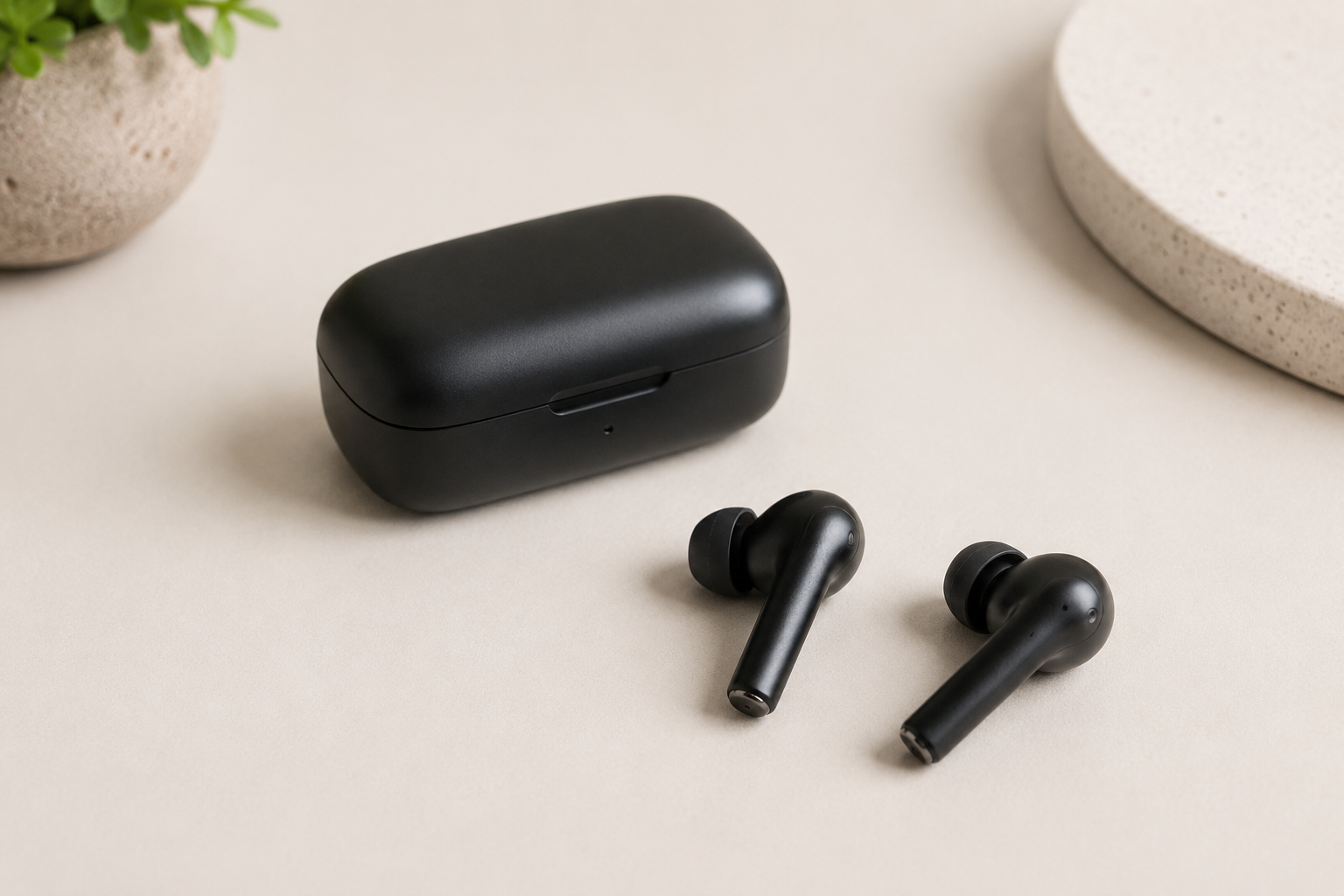
TWS stands for True Wireless Stereo. It means the earbuds have no wire anywhere in the system — not between the earbuds and your phone, and not between the left and right earbud either. Each earbud connects to your audio source independently over Bluetooth.
For buyers, distributors, and sourcing teams, this distinction matters. Some products marketed as "wireless" still use a hidden wire between the two earpieces. Listing them as TWS by mistake can cause product returns and catalog errors.
TWS is short for True Wireless Stereo. The word "true" is the key part: it tells you both earbuds work with zero physical cables anywhere.
Each earbud pairs with your phone or other audio source over Bluetooth, and the two earbuds also sync with each other over Bluetooth. This is what lets you hear separate left and right stereo channels with no wire at all.
"Wireless earbuds" is often used loosely to describe three different product types.
| Feature | Wired Earbuds | Neckband Bluetooth | TWS Earbuds |
|---|---|---|---|
| Cable to phone | Yes | No (Bluetooth) | No (Bluetooth) |
| Cable between earbuds | Yes | Yes | No |
| Charging needed | No | Yes | Yes |
| Loss risk | Low | Low | Higher — two separate parts |
If a product has any cord connecting the two earpieces, even a thin one behind the neck, it is a neckband-style Bluetooth headset, not TWS.
The dual-connection method (both earbuds linking to the phone directly) generally gives steadier audio and less left-right sync drift than the older relay method, since neither earbud depends on the other to receive its signal.
Latency is the delay between when a sound plays on your phone and when you hear it in your ears. It matters most for gaming and watching video, where audio needs to match what's on screen.
The Bluetooth codec a product uses sets the general range of possible latency, but it is not a fixed number. The actual delay on any given pair of earbuds also depends on the Bluetooth chip, firmware, and buffering, so two products using the same codec can still perform differently.
As an example of the scale involved, independent lab testing by RTINGS measured real delay on a specific Bluetooth headset: about 173 milliseconds using the standard SBC codec, versus about 34 milliseconds using aptX Low Latency mode on the same device (RTINGS, "Bluetooth Audio Latency Test"). SBC is the baseline codec required on all Bluetooth audio devices, so most TWS products support it even if they also offer better options (Feasycom, "Comparison of Bluetooth Audio Codecs"). aptX, aptX Low Latency, and similar codecs are not supported on Apple devices (Audio-Technica, "Differences Between Bluetooth Wireless Codecs").
For buyers, the practical takeaway is to ask for a tested latency figure for the specific product and phone combination you plan to sell, rather than relying on a codec name or a marketing phrase like "low latency."
TWS removes cable-related problems entirely — nothing to tangle, snag, or fray. Removing the headphone jack and connecting wire also frees up internal space for a larger battery or driver in the same size earbud.
Most TWS earbuds support hands-free calls, voice assistant access, and touch controls without needing to hold a phone. Many models also include active noise cancellation (ANC), which uses extra microphones and internal speakers to reduce outside noise.
Battery life is the main trade-off. TWS earbuds run entirely on a small internal battery, and ANC adds extra power draw because it constantly processes microphone input to generate a canceling signal. Any earbud with ANC will run for less time on a single charge with ANC turned on than with it off. When comparing products, check the spec sheet's ANC-on runtime specifically, since the ANC-off number is usually the one advertised more prominently.
The other real drawback is loss risk. Each earbud is a separate, small object, so it is easier to lose one earbud than to lose a single-piece headset. The charging case can also go missing, which affects your ability to recharge at all.
The only reliable test is the physical design: true TWS earbuds have no cable of any kind connecting the two earpieces. A Bluetooth version number, a charging case, or a listed codec does not confirm this on its own — some neckband or hybrid products also have these features.
Before adding a product to your catalog, ask the supplier for close-up photos of both earbuds separated from the case and from each other, or a component list showing that each earbud has its own Bluetooth radio. For new suppliers, ordering a small sample before a bulk order is the most reliable check.
For business buyers, the specs that matter most are: the Bluetooth version (later versions generally improve power efficiency and support features like multipoint connection), the supported audio codec (SBC is the baseline; aptX, AAC, or a dedicated low-latency mode are upgrades depending on your customer's use case), the ANC-on battery runtime specifically, and the IP water-resistance rating if the product targets sports or outdoor use.
Is TWS the same as regular wireless or Bluetooth earbuds?
Not always. "Wireless" is also used for neckband-style headsets, which remove the cable to your phone but keep a cord connecting the two earpieces. TWS specifically means no cables anywhere in the system.
Do TWS earbuds work with any phone?
Most modern phones support Bluetooth and will pair with TWS earbuds for basic playback. However, some higher-performance codecs, including aptX and aptX Low Latency, are not supported on Apple devices, so both audio quality and latency can vary by phone.
Why do my TWS earbuds cut out or disconnect in crowded places?
Bluetooth shares the same 2.4GHz frequency band as Wi-Fi routers and many other devices. In crowded areas with heavy wireless traffic, this can cause temporary signal interference and dropouts, separate from any latency issue.
How much does ANC actually reduce battery life?
The exact amount varies by product, since it depends on the microphone array and noise-cancelling chip used. As a rule, expect a noticeably shorter runtime with ANC on versus off, and compare the ANC-on figure specifically when checking spec sheets, not just the headline battery number.
TWS means True Wireless Stereo: no wire to your phone, and no wire between the two earbuds. For business buyers, the details that actually affect product quality are the Bluetooth chip design, the supported codec, tested latency, and ANC-on battery life — not marketing claims alone. Verifying these specs directly with your supplier, rather than trusting a listing description, is the safest way to avoid catalog errors and returns.